
Six steps in order: (1) test CYA first — if above 80 ppm, drain 1/3 to 1/2 before anything else, (2) adjust pH to 7.2-7.4, (3) brush all surfaces, (4) shock at 3 lbs per 10,000 gallons for light green, 5+ lbs for dark green or black, (5) run the filter continuously and backwash every 8-12 hours, (6) add polyquat 60 algaecide the next morning once FC drops below 4 ppm. Most pools clear in 2-5 days.
The most common reason green pool treatments fail is that pool owners skip Step 1. If CYA is above 80 ppm, no amount of shock will clear the pool. The CYA problem must be fixed first — everything else is secondary. Test before you treat.
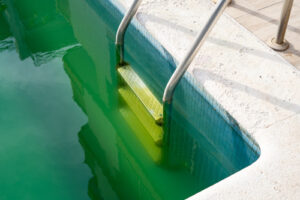 Step 1: Test CYA Before Adding Anything
Cyanuric acid above 80 ppm dramatically reduces how much of your free chlorine is in its active killing form (hypochlorous acid). You can shock a green pool repeatedly and watch the FC reading climb to 10 or 15 ppm, and the pool will stay green — because most of that chlorine is bound to CYA and not available to kill algae.
If CYA tests above 80 ppm per PHTA APSP-11 Standard: drain 1/3 to 1/2 of the pool volume and refill with fresh water before proceeding. This is non-negotiable. A pool at 100 ppm CYA that you drain by half and refill will come down to approximately 50 ppm — right in the effective range.
✓ KEY FACT: No chemical removes CYA from pool water. Dilution by draining and refilling is the only fix. Products marketed as ‘CYA removers’ are not recognized by PHTA and have not demonstrated consistent effectiveness in independent testing.
Source: PHTA APSP-11 Standard — CYA target 30-50 ppm, maximum 100 ppm
Step 2: Adjust pH to 7.2-7.4
Shock at lower pH is significantly more effective. Free chlorine operates primarily as hypochlorous acid (HOCl), the active killing form. In unstabilized pools, HOCl percentage is roughly 66% at pH 7.2 and drops to approximately 20% at pH 8.0. Even in stabilized pools, keeping pH in the lower range of the target window (7.2-7.4 versus 7.6-7.8) improves shock effectiveness.
Lower pH to 7.2-7.4 using sodium bisulfate before shocking. Do not shock at pH 8.0 — you will waste product and slow the recovery significantly.
Step 3: Brush All Pool Surfaces
Before adding any shock, brush the pool floor, walls, steps, and any ledges or benches thoroughly. Brushing does two things: it disrupts algae colonies that have attached to surfaces, and it removes the protective biofilm layer that algae produces to shield itself from chlorine. Algae killed on a surface still needs to be suspended into the water where the filter can capture it.
Use a stiff brush for plaster or concrete pools. Use a soft nylon brush for vinyl liner and fiberglass pools — stiff brushes scratch these surfaces. Brush in overlapping strokes toward the main drain.
Step 4: Shock at the Correct Dose for the Severity
| Pool Color | Algae Severity | Shock Dose (cal-hypo 68%) | Notes |
| Light green or teal | Early algae growth | 3 lbs per 10,000 gallons | FC will rise to approximately 20-30 ppm. Add after sunset. Pre-dissolve in bucket. |
| Medium green | Established algae bloom | 4-5 lbs per 10,000 gallons | Expect 2-3 days to clear. Run filter continuously. Backwash every 8-12 hours. |
| Dark green, swamp-like | Heavy algae infestation | 5-7 lbs per 10,000 gallons | May need second full shock treatment 24 hours later. Test FC before re-shocking. |
| Black-green or black algae visible | Black algae (most difficult) | 6-8 lbs per 10,000 gallons plus aggressive brushing | Black algae requires mechanical disruption — the protective head must be removed by brushing before shock can penetrate. May need 5-7 days. |
⚠ WARNING: NEVER mix cal-hypo shock with trichlor tablets in the same bucket or container. The reaction between these two chemicals is a documented fire and explosion hazard per PHTA safety guidelines. Pre-dissolve cal-hypo shock in a separate bucket of water and add to the pool separately from any tablet-based chlorine.
Source: PHTA Cal-Hypo Fact Sheet 2021 — mixing hazards; 68% calcium hypochlorite characteristics
✓ KEY FACT: Shock after sunset. UV from sunlight degrades shock before it can work. Add shock to the deep end of the pool, walking around the perimeter as you pour. Run the pump overnight at full speed — 8-10 hours minimum.
Step 5: Run the Filter Continuously and Backwash Frequently
Once the shock kills algae, the dead cells become fine suspended particles — this is when the pool turns from green to cloudy white or gray. That is the filter’s job to capture. The filter cannot do that job if it is clogged with dead algae.
Backwash sand or DE filters whenever pressure rises 8-10 psi above the clean baseline — during heavy algae treatment, this may happen every 8-12 hours. Rinse cartridge filters with a hose every 12-24 hours. A clogged filter dramatically extends clearing time. Clearing a green pool properly takes 2-5 days of continuous circulation, not one overnight run.
Bottom Line: The most common reason pools stay green or go from green to cloudy and stay cloudy: the filter is not being cleaned often enough. Every time you backwash during algae treatment, you remove the dead cells that would otherwise recycle back into the pool. Backwash more than you think you need to.
Step 6: Add Algaecide the Morning After Shocking
Add polyquat 60 algaecide only after FC drops below 4.0 ppm — typically the morning after the shock treatment. High FC deactivates algaecide before it can reach algae. At the correct timing, algaecide works alongside the residual chlorine to prevent the algae from re-establishing as the pool clears.
Do not use copper-based algaecides during a green pool treatment — copper can stain pool surfaces when FC is elevated, and the stains are permanent without a metal treatment process. Polyquat 60 is the correct choice for green pool recovery.
Timeline: What to Expect
| Day | What You Should See | What to Do |
| Day 0 (evening) | Pool is green | Test CYA, adjust pH, brush, shock at full dose, run pump overnight |
| Day 1 (morning) | Pool is cloudy gray or white — algae is dead | Add algaecide. Backwash filter. Check FC — if near zero, shock again. |
| Day 1-2 | Cloudiness beginning to clear from the bottom up | Run filter continuously. Backwash every 8-12 hours. Test FC daily. |
| Day 2-3 | Pool noticeably clearer, may still be hazy | Continue filter run. Add clarifier if cloudiness persists after 48 hours. |
| Day 3-5 | Pool clear or nearly clear | Test full chemistry. Adjust TA, pH, and calcium hardness to correct ranges. |
| Day 5+ | Pool still not clear | Test CYA. If above 80 ppm, partial drain required. Recheck filter condition. |
If X Happens, Do Y
I shocked and the pool is still green 24 hours later
Three possibilities: (1) CYA is above 80 ppm and the shock is not working — test CYA if you have not already, (2) FC dropped to zero overnight because the algae bloom is consuming chlorine faster than the shock can sustain — re-shock at the same dose, (3) the shock dose was insufficient — increase to 5+ lbs per 10,000 gallons and re-shock. Do not wait more than 24 hours to re-shock if FC is near zero.
The pool cleared to blue but algae came back within a week
One of three underlying problems was not addressed: (1) CYA is too high — chlorine is not effective enough at normal maintenance doses to prevent re-growth, (2) phosphate levels are feeding rapid algae regrowth — test phosphates if CYA is in range, (3) polyquat 60 algaecide was not added after treatment or not maintained weekly. Add algaecide weekly throughout the swim season, not just during treatments.
The pool is cloudy white after shocking but will not clear after 3 days
Check three things: (1) is the filter clean and backwashed — a saturated filter cannot capture fine dead algae particles, (2) is calcium hardness above 400 ppm — high calcium causes persistent white cloudiness from calcium carbonate precipitation that filtration alone cannot resolve, (3) add a pool clarifier to help aggregate fine particles for easier filter capture.
Related Guides
→ Pool Shock Guide: The Right Type, the Right Dose, the Mistakes That Make It Fail