
Late August through October is peak Atlantic hurricane season, and pool owners in coastal and Gulf states deal with this every year: the instinct to drain the pool before a storm is almost always the wrong call, and it causes more damage than the storm itself would have.
Do Not Drain Your Pool Before a Storm
This is the most common and most damaging mistake. An empty or nearly empty inground pool has no water weight holding the shell down against rising groundwater from storm rainfall. Heavy rain saturates the surrounding soil, and hydrostatic pressure can push an empty or low pool shell up out of the ground, a failure that costs tens of thousands of dollars to repair and sometimes can’t be fully repaired at all.
The water in your pool is doing structural work. Leave it mostly full.
Before the Storm: The Checklist
Lower the water level slightly, not drastically. A few inches below normal, similar to a standard winter closing level, gives the pool room to absorb rainfall overflow without over-diluting your chemistry, while keeping enough weight in the shell to resist groundwater pressure.
Turn off power to all equipment at the breaker. Pumps, heaters, salt chlorinators, and automation systems should be fully de-energized before the storm arrives, not just switched off at the equipment. Power surges and flooding around the pad are common during hurricanes, and de-energized equipment is much less likely to be damaged or to become an electrical hazard.
Remove or secure the automatic cleaner. Robotic cleaners should come out of the pool entirely and be stored indoors. Suction and pressure cleaner hoses should be disconnected and stored, both to prevent damage and to prevent the hose from becoming debris in high wind.
Take down or firmly secure pool covers. A solar cover or an unanchored winter cover can turn into a large, wind-caught sheet of material that damages property or injures someone. If a cover can’t be safely removed and stored, confirm every anchor point is intact and rated for the expected wind.
⚠ WARNING: Loose pool furniture, floats, skimmer lids, and deck decor are common sources of storm damage, both to the items themselves and to windows and siding they get blown into. Bring everything not permanently fixed indoors or into a garage before the storm. Preparing for hurricane season from the CDC
Add extra chlorine before the storm. Heavy rain dilutes pool chemistry significantly and introduces organic debris. Shocking the pool 1-2 days before expected landfall gives you a chlorine reserve that will still be meaningfully present after dilution, rather than starting from a normal maintenance level that gets wiped out entirely.
Cap or disconnect exposed electrical connections at the pad, particularly on older equipment pads without proper conduit sealing. Consult an electrician if you’re not certain a connection is watertight-rated.
After the Storm
Do not restore power to pool equipment until any standing floodwater around the equipment pad has fully receded and the equipment has had time to dry. Running a pump or heater that took on floodwater risks electrical damage and, more importantly, an electrical hazard to anyone near the pad or in the water.
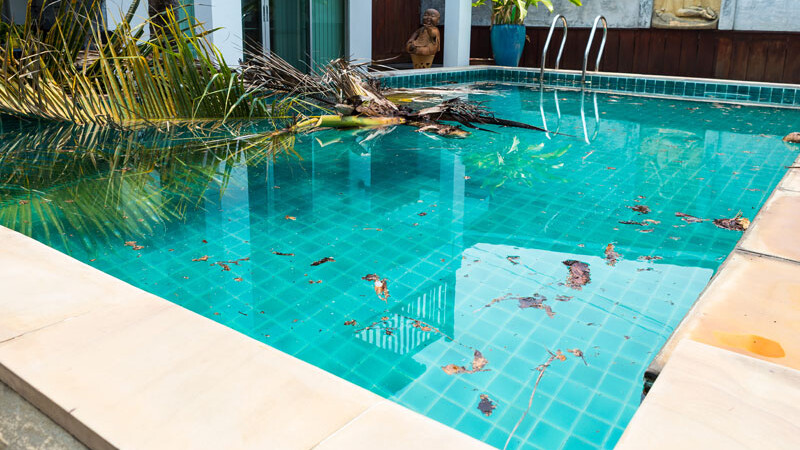
Test water chemistry before swimming. Storm runoff introduces bacteria, debris, and diluted chemistry that a visual check alone won’t catch. Shock the pool again after the storm passes if free chlorine has dropped, and expect to run the filter longer than usual to clear storm debris and runoff turbidity.
Inspect the pool structure, deck, and equipment pad for visible damage: cracks, shifted coping stones, or equipment that looks like it took on water. For inground pools with vinyl liners, check for new wrinkles or shifting, which can indicate the liner took on water pressure from behind during the storm.
If X Happens, Do Y- Hurricane Season & Pool Owners
My pool overflowed significantly during the storm and diluted my chemistry. Test all parameters once the storm passes, not just chlorine. Rebalance total alkalinity and pH first (heavy rain typically pushes both down initially; then pH rises as the water off-gasses CO2 over the following days), then shock, then retest CYA, since heavy dilution can meaningfully drop stabilizer levels.
Storm debris (leaves, branches, dirt) is heavy in the pool after the storm. Skim out large debris manually before running the filter, so the filter isn’t immediately overwhelmed. Expect to backwash a sand or DE filter more frequently than normal for the first week after a major storm, and rinse cartridge filters more often during that same window.
My pool equipment sat in floodwater during the storm. Do not power it on. Have an electrician or pool professional inspect any pump, heater, or salt chlorinator that was submerged or partially submerged before attempting to restart it. Water-damaged electrical components are a genuine safety hazard, not just a performance issue.
Where to Buy
Doheny’s carries winterizing-strength shock, extra algaecide, and cover anchors and accessories useful for storm prep, with free shipping on orders over $50 and next-day delivery on Doheny’s brand chemicals, which matters when a storm is approaching on short notice. Shop Doheny’s storm prep chemicals →