
Pool Filter: Cartridge vs. DE vs. Sand -- Which Is Right for Your Pool?
DE (diatomaceous earth) filters capture the finest particles — down to 2-5 microns. Cartridge filters capture 10-15 microns and require no backwashing. Sand filters capture 20-40 microns and are the most common and least expensive. For the clearest water possible, DE is best. For lowest maintenance, cartridge. For lowest cost, sand.
All three filter types can maintain a clear, safe pool. The differences are in filtration fineness, maintenance requirements, water usage, and upfront cost. The right choice depends on your priorities, not on which filter type is theoretically superior.
Side-by-Side Comparison
| Feature | Sand Filter | Cartridge Filter | DE Filter |
| Filtration fineness | 20-40 microns | 10-15 microns | 2-5 microns |
| Maintenance method | Backwash when pressure rises 8-10 psi above baseline | Remove and rinse with hose; no backwashing | Backwash + recharge with fresh DE powder |
| Water usage | High — backwashing uses 200-300+ gallons per cycle | Zero — no backwashing required | Moderate — backwashing uses less water than sand |
| Upfront cost | Lowest — $200-500 for most residential units | Mid-range — $300-700 | Highest — $400-900+ |
| Filter media replacement | Every 5-7 years (sand replacement) | Every 1-3 years (cartridge replacement) | Add DE after each backwash; grid replacement every 5-10 years |
| Operating pressure | Runs at higher pressure — 15-25 psi typical | Runs at lower pressure — 8-15 psi typical | Runs at lower pressure — 10-16 psi typical |
| Best for | Budget-conscious; high-debris pools | Low-maintenance; water-conservation areas; smaller pools | Clearest water; competition pools; high-clarity requirements |
| Chemical handling | None — sand is inert | None — cartridge is inert | DE powder is a respiratory hazard — handle with care, avoid inhaling |
Source: Filter micron ratings from manufacturer specifications; filtration industry standards
Sand Filters: The Details
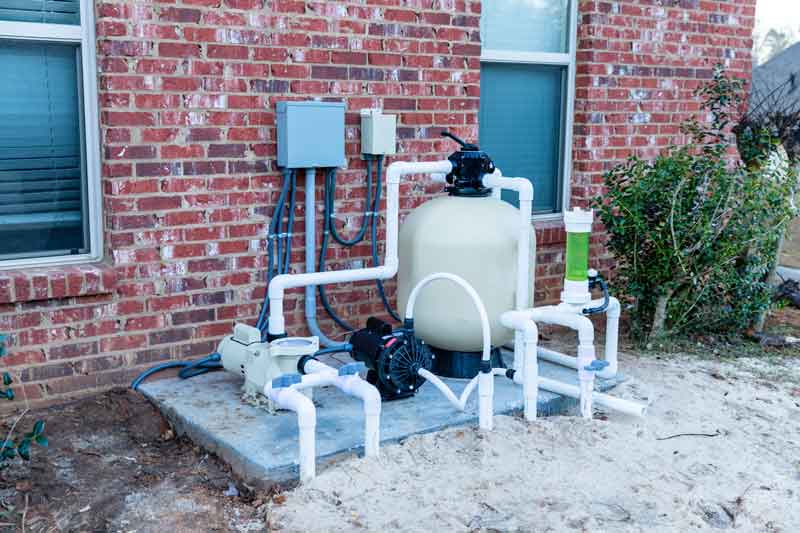
Sand filters are the most common residential pool filter type. They work by passing pool water through a bed of specially graded filter sand (typically #20 silica sand). Debris particles larger than 20-40 microns are trapped in the sand bed; cleaner water returns to the pool.
Maintenance
Backwash when the pressure gauge reads 8-10 psi above the clean baseline reading (not above a fixed number — above your specific filter’s baseline). Backwashing reverses water flow through the sand, flushing trapped debris out through the waste line. One backwash cycle uses 200-300+ gallons of pool water — a consideration in drought-prone regions or areas with water use restrictions.
Sand replacement: filter sand degrades over time as the sharp edges that trap particles wear smooth. Replace sand every 5-7 years. Signs it is time: water that stays cloudy despite correct chemistry and normal filter operation, or pressure that does not return to baseline after backwashing.
Filter sand alternatives
Two common sand alternatives improve filtration fineness without requiring a new filter:
- Zeolite: a natural mineral that filters to approximately 5 microns versus 20-40 for sand. Also has some ammonia-removal properties. Costs 2-3x more than sand. Direct replacement in most sand filters.
- Filter glass (recycled glass): filters to approximately 5-15 microns depending on media grade — finer than standard silica sand, though specific ratings vary by product. Does not harbor bacteria like sand can and requires less frequent backwashing. Costs 2-4x more than sand.
Cartridge Filters: The Details
Cartridge filters use a pleated polyester element to trap debris. Water passes through the pleated fabric; debris is captured on the surface. No backwashing — the cartridge is simply removed and rinsed with a garden hose when pressure rises.
Maintenance
Rinse the cartridge with a hose when pressure rises 8-10 psi above its clean baseline. For heavily used pools or pools near trees, this may be weekly. For lightly used pools, monthly is typical. Soak cartridges in a filter cleaning solution (muriatic acid dilution or commercial cartridge cleaner) once per season to remove oil, sunscreen residue, and mineral deposits that hose rinsing cannot remove.
Cartridge replacement: most residential cartridges last 1-3 years with proper maintenance. Signs it is time: visible tears, crushed pleats, or pressure that does not return to baseline after cleaning.
Where cartridge filters excel
Pools in water-restricted areas where backwashing waste is a concern. Smaller above-ground pools where lower-pressure operation matches the pump. Pools where the owner prioritizes low hands-on maintenance (no backwash valve to operate, no sand replacement). The absence of a backwash requirement does mean no quick pressure relief — cartridges must be physically removed and cleaned rather than running a 3-minute backwash cycle.
DE Filters: The Details
Diatomaceous earth filters use a powder made from fossilized remains of diatoms — microscopic algae — as the actual filter medium. The DE powder coats internal grids inside the filter tank. Water passes through the coated grids, and particles down to 2-5 microns are captured. This is the finest residential pool filtration available — DE filters can remove particles that pass through cartridge and sand filters entirely.
Maintenance
Backwash when pressure rises 8-10 psi above baseline — similar to sand. After backwashing, recharge the filter by adding fresh DE powder through the skimmer with the pump running. The amount of DE to add depends on the filter’s total square footage — typically 1 lb of DE per 10 square feet of filter area. Check the filter manufacturer’s label for the specific recharge amount.
⚠ WARNING: DE powder is a respiratory hazard. Diatomaceous earth particles are very fine and can cause lung damage with repeated inhalation. Always wear a dust mask when handling DE powder and avoid dry pouring in windy conditions. Wet the powder in a bucket before adding through the skimmer to minimize airborne dust.
Where DE filters excel
Pools where water clarity is the primary concern. Pools with fine debris (pollen, dust, fine sand, algae spores) that passes through sand and cartridge filters. Pools near pools stores where the owner wants the cleanest possible water and is comfortable with the additional maintenance steps.
When to Backwash — All Filter Types
| Indicator | Action |
| Pressure 8-10 psi above clean baseline | Backwash sand or DE filter. Rinse or soak cartridge filter. |
| Water clarity deteriorating despite correct chemistry | Check filter pressure. If not elevated, the filter may be bypassing — check O-ring and valve seals. |
| After treating a green pool or heavy algae | Backwash or clean filter every 8-12 hours during the first 48 hours of treatment — dead algae loads the filter rapidly. |
| After a heavy rainstorm | Check pressure 24 hours after rain — debris and runoff often causes a pressure spike. |
| At pool opening | Backwash or clean filter before starting the season even if pressure appears normal — off-season debris may have accumulated. |
If X Happens, Do Y
My filter pressure never rises — pool stays cloudy
A filter that never rises in pressure may be bypassing — water is finding a path around the filter media rather than through it. Check: (1) is the multi-port valve in the correct ‘filter’ position, (2) is the filter tank O-ring seated correctly and undamaged, (3) for sand filters — has the laterals at the bottom of the tank cracked, allowing sand to bypass into the pool. A cloudy pool with no pressure rise almost always indicates a bypass problem, not a chemistry problem.
My filter pressure drops on its own without backwashing
A dropping pressure gauge indicates an air leak on the suction side of the pump — air is entering the system and compressing in the filter tank, reducing the water column and the pressure reading. Check the pump lid O-ring, any unions or fittings on the suction line, and the skimmer connection. An air leak also reduces effective flow rate and filtration performance significantly.
DE powder is coming back into the pool through the return jets
A DE grid (internal filter element) is torn or broken, allowing DE to bypass the filter and return to the pool. Disassemble the filter, inspect all grids for tears, and replace any damaged grids. After replacing, recharge with fresh DE at the correct dose. Running DE into a pool is not a health hazard in small quantities, but the filter is not functioning correctly until the grid is replaced.
Related Guides
→ 2026 Pool Opening and Maintenance Checklist