
How Often Should You Test Pool Water? The Testing Schedule That Actually Works
Test your pool’s free chlorine and pH at least twice per week during peak swim season. Test total alkalinity, CYA, and calcium hardness monthly. After heavy rain, a pool party, or any significant event, test before the next swim. The frequency that prevents problems is always higher than the frequency that reacts to them.
Under-testing is the most common cause of persistent pool chemistry problems. By the time you can see an issue — green water, cloudiness, eye irritation — the chemistry has been out of range for days. Testing your pool twice per week catches drift before it becomes a problem that costs $100+ in extra chemicals to fix.
The Complete Testing Schedule
| Parameter | Test Frequency | Target Range | Why This Frequency |
| Free chlorine (FC) | Twice per week minimum; daily in hot weather or heavy use | 1.0-4.0 ppm | FC is consumed daily by UV, bathers, and organic load. It can drop from 3.0 to near zero in 24-48 hours in hot weather. |
| pH | Twice per week minimum | 7.2-7.8 | pH drifts upward constantly in most pools from aeration, bather load, and trichlor chemistry. Catching drift early requires less acid to correct. |
| Total alkalinity (TA) | Monthly | 80-120 ppm | TA changes slowly. Monthly testing is sufficient unless you are making large pH corrections. |
| Cyanuric acid (CYA) | Monthly | 30-50 ppm (max 100) | CYA accumulates from trichlor tablets and cannot be reversed without draining. Monthly testing catches accumulation before it reaches problematic levels. |
| Calcium hardness (CH) | Monthly | 200-400 ppm | CH changes slowly. Monthly testing is adequate for most pools. |
| Combined chlorine (CC) | Monthly or when chlorine odor is noticeable | Below 0.5 ppm | CC above 0.5 ppm per PHTA guidelines means shock is needed. Strong chlorine smell is the symptom — CC is the cause. |
| After heavy rain | Test FC and pH within 24 hours | All parameters | Rain dilutes chemistry, raises TA and pH, and introduces organic load that drives FC down rapidly. |
| After a pool party (10+ swimmers) | Test FC same evening or next morning | FC minimum 1.0 ppm | High bather load depletes FC significantly. Test before allowing continued swimming. |
Source: PHTA guidelines — free chlorine 1.0-4.0 ppm; combined chlorine below 0.5 ppm; CYA target 30-50 ppm
Test Kit vs. Test Strips: Which Is More Accurate?
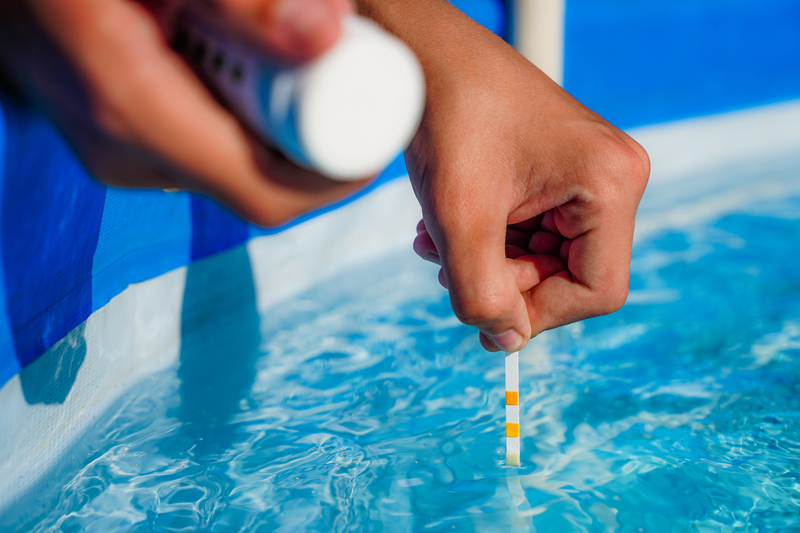
For routine twice-weekly testing, quality 5-way test strips are adequate for free chlorine and pH monitoring. They are fast and convenient.
For diagnosing persistent problems — recurring algae, chlorine that keeps crashing, cloudiness that does not clear — liquid DPD test kits (Taylor K-2006 FAS-DPD or equivalent) are significantly more accurate, particularly for CYA and combined chlorine. Test strips cannot measure CYA or combined chlorine accurately.
| Test Method | Measures Accurately | Does Not Measure Well | Best For |
| 5-way test strips | FC (approximate), pH (approximate), TA (approximate), CH (approximate), CYA (turbidity comparison only) | Combined chlorine, precise CYA above 50 ppm | Routine twice-weekly FC and pH monitoring |
| Liquid DPD test kit (Taylor K-2006 FAS-DPD) | FC, CC, pH, TA, CH, CYA — all with high accuracy | Nothing — this is the professional standard | Diagnosing problems; monthly comprehensive testing; any time test strips give suspect results |
| Digital test meter (ORP/pH) | pH and ORP (oxidation-reduction potential) — fast and precise | Cannot measure CYA, TA, CH, or CC | Daily FC monitoring in pools with stable CYA; not a substitute for full chemistry testing |
What Happens When You Don’t Test Often Enough
| Skipped Test | What Goes Undetected | Consequence |
| FC (skipped for 1 week) | FC has dropped below 1.0 ppm for several days | Algae begins establishing. By the time it is visible, 2-5 days of treatment are needed. |
| pH (skipped for 2 weeks) | pH has drifted to 8.0+ from aeration and bather load | Chlorine operating at reduced effectiveness. Swimmer eye irritation. Scale beginning to form on equipment. |
| CYA (skipped all season) | CYA has accumulated to 90-100+ ppm from trichlor tablets | Chlorine is present but largely inactive. Pool prone to recurring algae despite apparent normal FC readings. |
| CC (skipped until odor appears) | Combined chlorine has been above 0.5 ppm for weeks | Ongoing chloramine exposure for swimmers. Chlorine smell that most people incorrectly attribute to too much chlorine. |
| CH (skipped all season) | Calcium hardness has risen above 400 ppm from cal-hypo shock | Persistent cloudiness, scale deposits on equipment, and scaling at the waterline. |
The Minimum Viable Testing Schedule
If you can only commit to one consistent testing habit, this is the schedule that prevents the most problems:
- Test FC and pH every Tuesday and Saturday before adding any chemicals
- Test TA, CYA, and CH on the first Saturday of each month
- Test FC within 24 hours after any heavy rain or pool party
Bottom Line: Two tests per week takes less than 5 minutes. A pool that goes green takes 2-5 days and $50-150 in extra chemicals to fix. The testing habit is the single highest-leverage pool maintenance practice.
When to Take a Sample to a Pool Store
A professional pool store’s electronic water testing device is useful three times per season: at opening (to establish a baseline before adding any chemicals), at mid-season (to check CYA and metal levels that basic test kits miss), and when you have a persistent problem that your home testing cannot diagnose. Most major pool supply retailers offer free electronic water testing — bring a sample in a clean container from 12-18 inches below the water surface (not from the skimmer).
If X Happens, Do Y
My test strips give a different reading than a pool store electronic test
Trust the electronic test for any parameter where there is a significant difference. Test strips are subject to humidity degradation (moisture in the container causes false low readings), UV degradation (stored in sunlight), and reagent age (more than 1-2 years old). Electronic testing is more precise than strips for FC, pH, and especially CYA. Replace test strips annually and store in a cool, dry location.
My liquid test kit reads a color I cannot match on the comparator
For FC: if the sample bleaches out completely to clear, the FC is above the test kit range (typically above 10 ppm for DPD). Dilute the sample 50/50 with distilled water and multiply the result by 2. For pH: colors that fall between the comparator blocks are common — estimate between them. For CYA: the turbidity comparison tube requires consistent lighting — test in consistent indirect daylight, not direct sun or fluorescent light.
Related Guides
→ Pool Chemical Buying Guide: Everything You Need, Nothing You Don’t